
Current Monitoring & ADCP Surveys
- Home
- Services
- Oceanographic Survey
- Current Monitoring & ADCP Surveys
Any Questions? Let’s talk
+971 4 3271414
Related Services
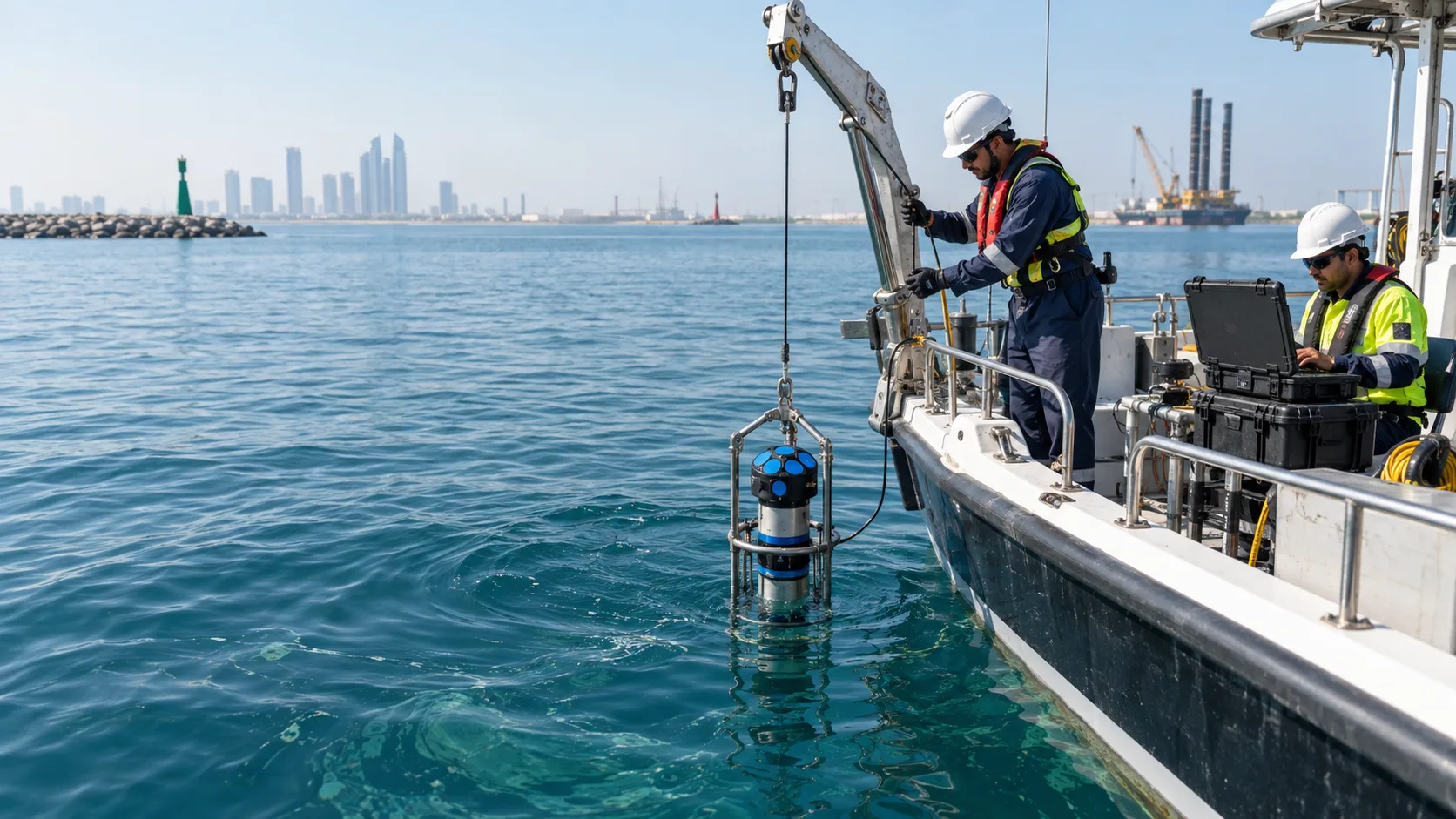
ADCP Current Monitoring
Falcon provides current monitoring surveys to measure water-current speed and direction throughout the water column. These surveys provide essential data for marine engineering, coastal development, dredging, offshore construction, renewable energy projects, and environmental studies. Accurate current profiles help engineers and marine specialists understand water movement and make informed decisions during project planning and execution.
With the growth of offshore renewable energy and coastal development projects, reliable current monitoring has become increasingly important. Environmental rehabilitation initiatives depend on accurate current measurements to support successful outcomes, while coastal engineering projects require reliable tidal and current data to reduce risks during construction and operation. By providing detailed tidal flow profiles using ADCP surveys, Falcon helps clients assess site conditions, improve project planning, enhance maritime operational safety, and reduce potential project risks.
Wave Measurement
Selected ADCP systems can measure wave characteristics in addition to water-current profiles, providing a more comprehensive understanding of marine conditions. Wave data can support offshore engineering, coastal development, renewable energy projects, and other marine applications where accurate knowledge of wave and current conditions is required.
Tide & Water Level Monitoring
Our ADCP systems can also measure water level and tidal variations during current monitoring surveys. We are supporting coastal engineering, navigation, dredging operations, environmental monitoring, and marine construction projects by providing a better understanding of changing water levels and tidal conditions.
Bottom-Mounted ADCP Deployment
For continuous monitoring, ADCP instruments can be deployed on the seabed and configured for short-term or long-term data collection, depending on project requirements. This deployment method is suitable for monitoring current speed and direction at different depths over a defined period.
Vessel-Mounted / Mobile Current Profiling
Where spatial coverage is required, ADCP measurements can be conducted from a survey vessel along defined transects or across specific project areas. Mobile profiling helps identify changes in current conditions across larger areas and provides valuable data for marine and coastal investigations.
Current Direction & Velocity Analysis
Collected ADCP data can be analyzed to identify variations in current speed and direction throughout the water column. Depending on the instrument and deployment configuration, the assessment can provide information on surface, mid-water, and near-bed current conditions to support engineering, environmental, and marine planning requirements.
Our Recorded current data can be processed to assess:
- Current speed
- Current direction
- Variation with depth
- Variation with time
- Flood and ebb current patterns
- Maximum and average current conditions
Long-Term Current Monitoring
We offer long-term ADCP deployments for ongoing freshwater and marine environment monitoring. Our extended deployments can be carried out where longer-duration datasets are required for engineering design, environmental studies or numerical modelling.
Typical Applications
- Ports and harbours
- Dredging and reclamation projects
- Coastal engineering studies
- Offshore and nearshore developments
- Pipeline and cable projectstem
- Intake and outfall studies
- Environmental baseline studies
- Sediment transport studies
- Numerical hydrodynamic modelling
- Marine construction planning
Oceanographic surveys provide reliable information about marine environments, seabed conditions, water characteristics, and coastal processes. Using advanced hydrographic equipment, marine sensors, and data-processing technologies, we collect accurate field data to support marine construction, offshore development, environmental studies, and coastal management projects.
Our oceanographic survey methods combine field measurements, remote sensing, underwater monitoring, and geospatial analysis to deliver a complete understanding of marine conditions.
Acoustic Doppler Current Profiler – ADCP
Used to measure current speed and direction through different depths of the water column.
ADCP is one of the standard instruments used for current monitoring; NOAA describes bottom-mounted and vessel-mounted ADCPs as common current-measurement systems.
Wave Monitoring Systems
Used to measure parameters such as wave height, period and direction, depending on the selected instrument/system.
Tide Gauge / Water-Level Monitoring
Used to continuously measure variations in sea level and tidal water levels over the monitoring period.
Tide/water-level measurement is a fundamental oceanographic activity and is noticeably missing from Falcon’s current service list. NOAA similarly treats continuous water-level monitoring as a core oceanographic observation.
CTD / Water-Column Profiling
Long-Term Current Monitoring

Contact Info
- 209, 2nd Floor, Apricot Tower P.O. Box : 238544, Dubai Silicon Oasis Dubai - United Arab Emirates
- info@falconsurveyme.com
- +971 4 327 1414
- +971 4 327 1413
- Monday - Saturday: 08.00 AM to 06.00 PM | Sunday is Closed
Social Links