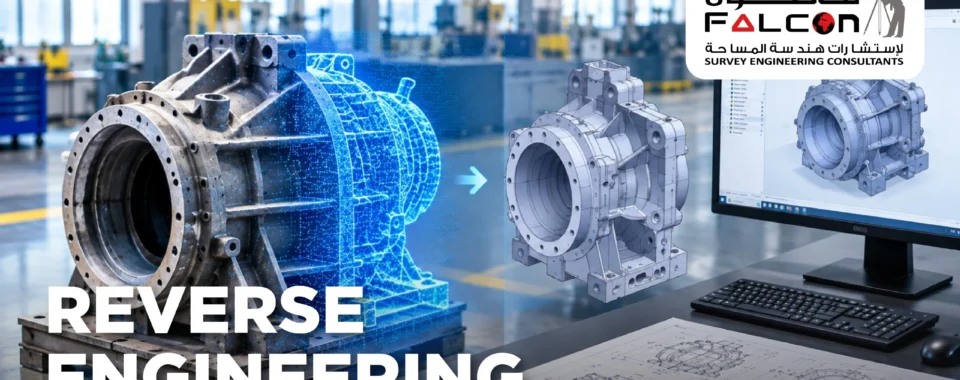
The reverse design process for a part or tool is referred to as reverse engineering, sometimes called back engineering or backward engineering. Here, the data is obtained directly from the part or tool itself, in contrast to the traditional development process for a part, where the design data is usually accessible ahead.
Reverse engineering is an important engineering process used to understand, document, recreate, or improve an existing physical object or component. With modern 3D laser scanning, reverse engineering has become more efficient because detailed geometric information can be captured digitally and converted into usable 3D models and CAD data.
What Is Reverse Engineering?
Reverse engineering works backward from an existing physical object to understand its dimensions, shape, features, and design. Instead of creating a design from the beginning, engineers start with the physical component and develop accurate digital information from it.
In 3D scanning applications, the process typically begins by capturing the object’s geometry as a point cloud. The data can then be processed into a mesh, surface model, or editable CAD model depending on the project’s requirements.
How 3D Laser Scanning Supports Reverse Engineering
Traditional measurement methods can be difficult when working with complex curves, irregular surfaces, large components, or intricate assemblies. 3D laser scanning captures a large amount of geometric information from the object’s surface, providing a detailed digital representation for further engineering work.
Benefits of Reverse Engineering
-
Recreate Missing or Outdated Designs
Older components may have incomplete, outdated, or unavailable drawings. Reverse engineering can help create new digital documentation from the existing physical component.
-
Create Replacement Parts
When original components are discontinued or difficult to source, captured geometry can provide a reference for designing replacement parts.
-
Support Product Improvement
Existing components can be digitally analysed and modified to support redesign, upgrades, or performance improvements.
-
Capture Complex Geometry
3D scanning is particularly useful for components with complex curves, free-form surfaces, and detailed features that can be difficult to measure manually.
-
Improve Digital Documentation
Reverse engineering can create accurate digital records of existing equipment, components, structures, and assets for future engineering and maintenance requirements.
Common Applications of Reverse Engineering
Reverse engineering with 3D scanning is used across many industries, including:
Manufacturing – Recreating and modifying existing components
Automotive – Vehicle components, replacement parts, and design development
Industrial Equipment – Machinery and equipment documentation
Architecture and Construction – Existing-condition documentation and as-built modelling
Energy and Power Plants – Capturing existing equipment and plant components
Aerospace – Detailed inspection, documentation, and component reconstruction
Heritage Projects – Digitally documenting existing structures and objects
Product Development – Creating digital models for redesign and improvement
Improving Engineering Accuracy with 3D Laser Scanning
3D laser scanning plays an important role in modern reverse engineering by capturing thousands or millions of precise measurement points from an existing physical asset. These measurements are processed into a registered point cloud, which can then be used to develop meshes, CAD models, drawings, and other digital deliverables.
Reverse Engineering Services by Falcon Survey
At Falcon Survey, we use advanced 3D laser scanning services in Saudi and UAE and technology to capture detailed information from existing components, structures, equipment, and facilities. Our reverse engineering solutions can support CAD modelling, as-built documentation, component recreation, design modifications, and engineering analysis.By converting physical assets into accurate digital data, reverse engineering helps clients make informed engineering decisions while reducing the need for repeated manual measurements.
Reverse engineering is a practical solution for projects where existing physical assets need to be accurately documented, recreated, modified, or improved. Combined with 3D laser scanning, it provides detailed geometric information that can be transformed into useful digital models and engineering documentation.
From replacement components and industrial equipment to buildings and complex facilities, reverse engineering helps bridge the gap between existing physical assets and modern digital engineering workflows.